


Agriculture Doesn’t Just Need Data. It Needs AI-Ready Data.

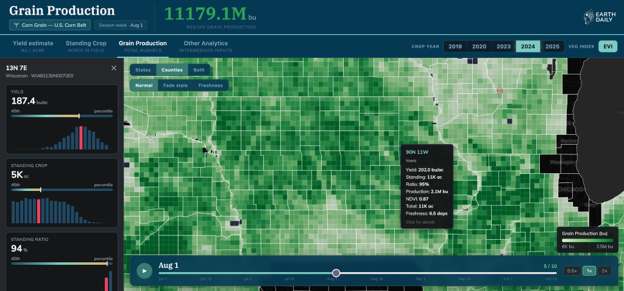
A grain production view from EarthDaily’s Territory Insights platform, showing how consistent agricultural data can support faster crop monitoring and yield assessment. Source: EarthDaily
The agricultural industry is caught in a paradox of abundance and absence. For more than a decade, the narrative of digital agriculture has been defined by a race for more: more satellites, more IoT sensors, more platforms, and more “big data.” That race has created an enormous volume of agricultural information. But it has not solved the harder problem: whether the right data is available at the right time, with enough consistency to support real-world decisions.
Today, we can monitor crop stress, field variability, and changing growing conditions from orbit at increasingly useful levels of detail. Yet availability remains uneven, especially when cloud cover, revisit timing, and seasonal decision windows are taken into account. In agriculture, a missed observation at the wrong moment can mean the signal arrives too late to matter.
The capability is growing. What is still missing is the ability to use that data consistently inside real-world systems. Recent work by the World Bank on AI foundations points to a gap between access to digital infrastructure and actual adoption.
For agriculture, every new data source only becomes useful if it improves consistency, reduces uncertainty, and helps decisions move faster. Without that foundation, more observations can create more noise. An FAO scientific assessment released around COP30 last year on the interactions between climate and food systems underscores the urgency of this shift. As climate change puts greater pressure on food systems and makes older weather-based models less reliable, agriculture needs more precise observations of real field conditions — not simply more data, but data that is timely, consistent, calibrated, and ready for AI.


The shift is from imagery people inspect to measurements machines can trust.
Where Systems Break
Remote sensing has become the backbone of landscape monitoring, but it remains an amplifier, not a shortcut. The FAO’s assessment is blunt about why: it identifies “the lack of standardized, high-quality datasets” as a significant barrier to AI adoption in agriculture — precisely because agricultural systems span climatic, biological, and management factors that require extensive, consistent data to model and decide on reliably.
Agriculture operates under tight timing constraints. Planting windows, input applications, risk monitoring, and harvest decisions all depend on signals that are both timely and reliable. Digital systems perform well in controlled environments. Models are tuned to specific soil types, gaps are handled manually, and sensors are calibrated for a single season.
In real-world conditions, that stability doesn’t hold. Differences in sensors, atmospheric conditions, revisit patterns, and processing pipelines begin to interfere with the signal. As inconsistencies accumulate, it becomes harder to distinguish real agricultural change from variation introduced by the data itself. A model flags crop stress, but the apparent change is caused by haze, off-nadir geometry, different sensor response, or a gap-filled image during a cloudy week — not by the crop.
In many workflows, the majority of effort still goes into preparing the data — normalizing, harmonizing, formatting, and correcting it before it can be used. AI can help accelerate some of that preparation, but it cannot turn noisy, inconsistent inputs into reliable intelligence. Time spent repairing the data is time not spent creating value from it. That delay matters, because environmental change does not pause, and agricultural planning cannot rely on occasional snapshots or unstable signals.
From Observation to Representation
To break this cycle, the industry must undergo a fundamental shift in how data is defined and used. Much of the current ecosystem is still built around ‘pictures’. That model reflects an earlier phase of Earth observation, when access to data was limited and each image represented a discrete observation.
Agriculture, however, does not operate on isolated observations. It depends on change across time and large expanses of land, which requires measurements that remain stable across seasons, regions, sensors, and conditions.
Imagery, when not consistently calibrated and normalized, is inherently variable. Illumination shifts, viewing geometry changes, and atmospheric conditions introduce differences that can rival the underlying signal being measured. Even small radiometric variations can distort interpretation when systems attempt to compare observations across time.
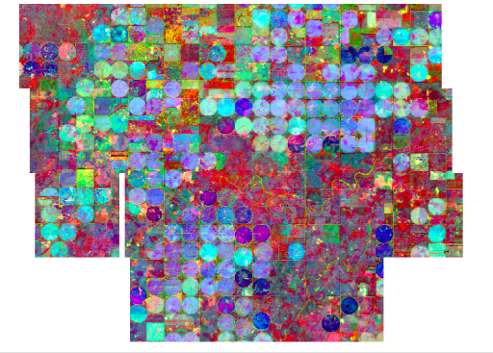
Embeddings translate agricultural measurements into machine-readable representations, helping AI systems compare crop conditions across time, geography, and growing seasons. Source: EarthDaily
When data is calibrated, consistent, and comparable across time, change can be tracked directly – signals persist, models stabilize, and workflows carry forward without being rebuilt.
Embeddings translate agricultural measurements into machine-readable representations, helping AI systems compare crop conditions across time, geography, and growing seasons. Source: EarthDaily
But stabilizing the signal is not enough. AI systems rely on structured representations of relationships across time, geography, and conditions. Crop condition links to weather, stress signals to yield outcomes, and timing to intervention windows. Without that structure, each new dataset resets the problem and models have to relearn the same patterns.
The next step is not simply cleaner imagery. It is persistent field-level representations: machine-readable summaries of crop condition, weather exposure, soil context, and management history that can be compared across time and reused by models. This is where embeddings become useful. They translate measurements into machine-usable representations that preserve these relationships. Once that structure exists, systems stop resetting. Patterns transfer across regions and seasons, and intelligence begins to accumulate rather than restart.
This is the shift the industry has not yet fully made.
The Path Forward: Defining AI-Ready Standards
FAO points in the same direction: AI adoption in agriculture depends on standardized, high-quality datasets that can handle climatic, biological, and management complexity. That requires integrating data across time and space in a way that can be used directly within operational workflows.
To move beyond pilots, agribusiness leaders should demand three things from their technology partners:
- Calibration over resolution: For decisions that track change over time, high-resolution imagery has limited value if the measurements behind the pixels are unstable or inconsistent.
- Temporal consistency: AI needs a stable view of the growing season over time, not disconnected snapshots.
- No-touch workflows: If data has to be manually harmonized before every use, the system is not scalable.
Few supply chains are as exposed to physical reality as agriculture. Production decisions are shaped by weather, soil, water, crop condition, regulation, and market volatility, often within narrow windows where timing matters. AI has the potential to help manage that complexity, but only if it is built on data that holds up under real conditions.
The industry has made enormous progress on access. The next step is usability: data that is consistent enough, timely enough, and structured enough to move directly into decisions.
Agriculture does not need another layer of data complexity. It needs systems that reduce the burden of preparation and deliver answers faster.
Subscribe Today For