



Precision Fruit Growing: How a Dutch Ag Tech Company Is Using an ROI Calculation Model from a Student
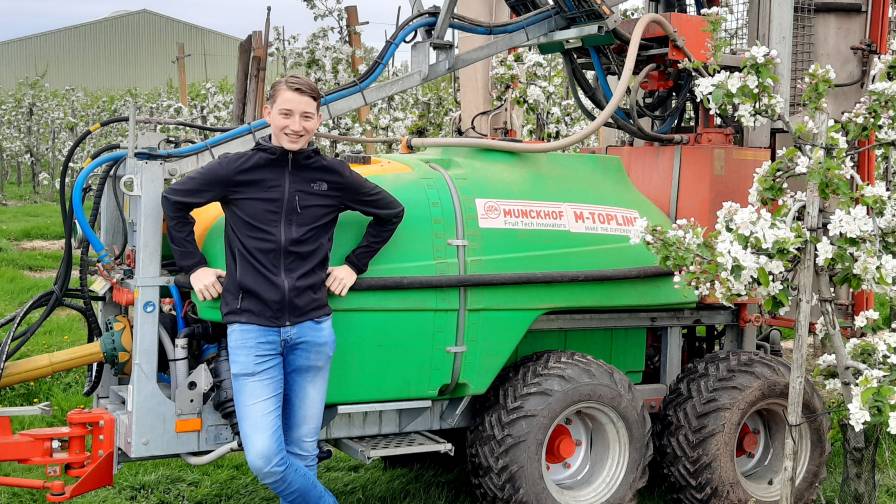
Luuk Tijssen, a student at the HAS in Den Bosch, The Netherlands, and son of a fruit grower in Altforst, has developed a calculation model to show the financial benefits of precision fruit growing at farm level.
Precision fruit growing is about using new techniques to improve the productivity, efficiency and sustainability of fruit farms. The implementation of precision fruit growing requires considerable investment in technology. Fruit growers need facts and figures on the economic yield and payback period. Luuk Tijssen, a student at the HAS in Den Bosch, The Netherlands, and son of a fruit grower in Altforst, has developed a calculation model to show the financial benefits of precision fruit growing at farm level. This makes it possible to calculate how interesting the investment is for each fruit grower.
Technical innovation in fruit growing
Precision fruit growing involves a range of advanced techniques, including the use of drones, GPS and camera techniques to collect accurate orchard data. Munckhof Fruit Tech Innovators is a pioneer in the development of these technologies for application in fruit growing. By using drone imagery and new data processing techniques, they can collect detailed information on parameters such as flower density, vigor and the number and size of fruit harvested at tree level. Munckhof integrates this data from the orchard with its sprayers, root pruners and harvesting machines. This enables fruit growers to achieve a homogeneous harvest with higher yields and better quality.
Higher yields and cost savings
Data from the orchard can be used in various ways to achieve better economic results in the short and longer term. Drone recordings of flower density, for example, can be converted into digital task maps to control precision sprayers and root pruners in combination with GPS technology. The automatic counting of picked fruit per tree provides valuable information for the development of even better cultivation plans. With this information, fruit growers can make accurate decisions about spraying and root pruning for each individual fruit tree. By translating this information into automatic task schedules for the sprayer and root pruner, each treatment can be applied just right for each tree. This results in better yields and higher quality while saving on spraying and labor. In addition, precision spraying against the pear bud blight, for example, ensures better species diversity and, with the right flower thinning, reduces the natural sensitivity for the following year’s turn of the year.
Luuk Tijssen’s calculation model
Luuk Tijssen, a student of Business Administration and Agribusiness at the HAS, has developed a mathematical model to quantify the economic benefits of precision fruit growing. For his research, he collected data from Fruit 4.0 of Wageningen WUR, fruit growers, Rabobank and fruit-growing consultants. He focused on determining the financial benefits of precision fruit growing in terms of yields per hectare, yields per kilo and savings in resources and labor. The calculation model takes into account several parameters, including fruit varieties and farm size. He focused the calculation model on the three most important techniques for precision fruit growing: spraying, root pruning and automatic crop registration at harvest. Luuk’s research shows that investments in precision fruit growing make the most economic sense for varieties that are prone to thinning and/or rotation years, such as Elstar, Kanzi, SPRANK, Gala and Golden Delicious. One of the farms surveyed, for example, has 18 hectares of apples, half of which are susceptible to thinning and/or fruit set; a GPS application on the sprayer and root knife paid for itself within a year. The payback period for an M-Connect data link for harvest recording in this situation is around four years.
MORE BY GLOBAL AG TECH INITIATIVE



Application of the Munckhof calculation model in practice
Munckhof Fruit Tech Innovators is enthusiastic about Luuk Tijssen’s calculation model. “We already know a lot about precision fruit growing in general,” according to a press release from the company. “Precision fruit growing requires an investment in time and money. Every orchard is different. Not only in terms of size, but above all because of the differences and combinations of fruit varieties grown. For Munckhof, Luuk Tijssen’s calculation model is a godsend.
“We can use it to calculate the economic benefits and payback periods of precision fruit growing methods together with our customers. By entering the correct operating data, fruit growers gain an insight into the potential profitability of investments in precision fruit growing. The calculation model makes investments in precision fruit growing transparent. It facilitates decision-making and minimizes risks. It enables fruit growers to manage their capital more efficiently and optimize their operational performance.”
Subscribe Today For